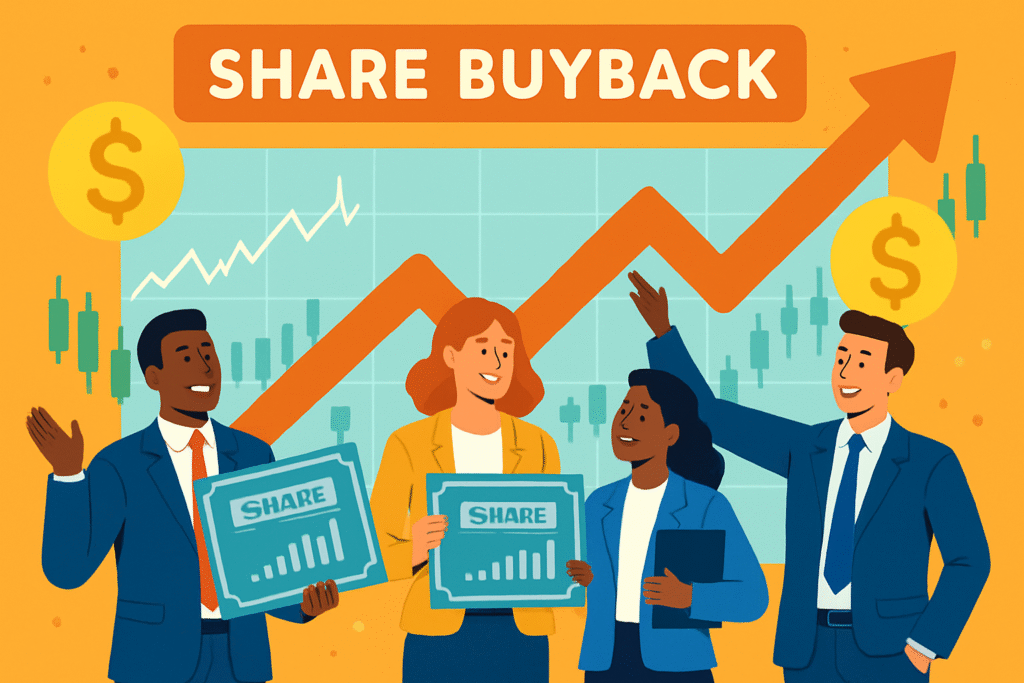
If you’ve been following the U.S. stock market lately, you’ve probably noticed one headline that just won’t go away:
“Companies are buying back their own shares like never before.”
And it’s not hype — 2025 is already a blockbuster year for corporate share repurchases.
By August, U.S. companies had announced a jaw-dropping $983.6 billion worth of buybacks. At this pace, we’re set to smash past $1.1 trillion by the end of the year. For perspective, 2024 was already a record-breaker at $942.5 billion — and we’ve blown past that momentum.
So, what’s driving this frenzy? Who’s leading the charge? And should investors be excited… or concerned? Let’s dig in.
1. The Biggest Players in the Buyback Game
Unsurprisingly, big tech and big banks are dominating.
- Tech Titans:
Apple approved up to $100 billion in repurchases, while Alphabet (Google’s parent company) is following with $70 billion. In Q1 2025 alone, the Information Technology sector spent $80.2 billion on buybacks — up 25.8% from last year. - Wall Street Powerhouses:
- Banks are back in a big way. With some regulatory restrictions eased, JPMorgan Chase announced $50 billion, Bank of America is spending $40 billion, and Morgan Stanley green-lit $20 billion. Overall, financial sector buybacks jumped 41% in Q1.
2. Why Companies Are Buying Back Shares
Think of a buyback as a company investing in itself. By reducing the number of outstanding shares, they can boost earnings per share (EPS) — which often pushes the stock price higher.
Key reasons fueling 2025’s buyback surge:
- Cash reserves are overflowing from strong profits and past tax cuts.
- Economic uncertainty makes big expansion projects risky, so buybacks feel safer.
- Market stability — repurchases can help steady a stock during volatile periods.
Howard Silverblatt of S&P Dow Jones Indices summed it up: companies “bulked up on buybacks” before potential market turbulence from trade and tariff concerns.
3. The Controversy: Critics Aren’t Convinced
Not everyone thinks this is good news.
Common criticisms include:
- Short-term focus — buybacks can boost stock prices temporarily but may not improve the company’s long-term health.
- Insider advantage — executives sometimes sell their own shares right after a buyback announcement.
- Missed opportunities — funds spent on buybacks could go toward R&D, employee pay, or infrastructure.
Boeing’s past troubles are often cited as a cautionary tale — prioritizing buybacks over innovation can hurt competitiveness.
4. Regulation: The 1% Buyback Tax
The U.S. implemented a 1% excise tax on net buybacks in 2023. In early 2025, it shaved roughly 0.50% off S&P 500 operating earnings — but it hasn’t slowed activity at all. If anything, companies seem unfazed and are continuing full speed.
5. What It Means for Investors
If you own shares in companies running large buyback programs:
- You might benefit through potential stock price appreciation and higher EPS.
- But don’t get blinded by the headlines — buybacks can’t save a weak business model.
- Always check the company’s financial health, growth plans, and industry outlook before celebrating.
✅ Bottom Line
2025’s buyback boom is rewriting Wall Street history. It’s part smart capital allocation, part market psychology, and part corporate showmanship.
Whether you see it as a bullish signal or a warning sign, one thing is clear: this is one of the defining financial stories of the year.
Related Posts You May Love:
- Top 5 High-Growth Mutual Funds for SIP in 2025 to Safely Build ₹1 Crore Corpus
- Top 5 Mutual Fund Apps for Beginners (2025 Guide)
- How to Start Investing in the Indian Stock Market with Just ₹1000
- 5 Intraday Trading Strategies That Actually Work for Beginners with ₹10,000 Capital
Can you be more specific about the content of your article? After reading it, I still have some doubts. Hope you can help me.